


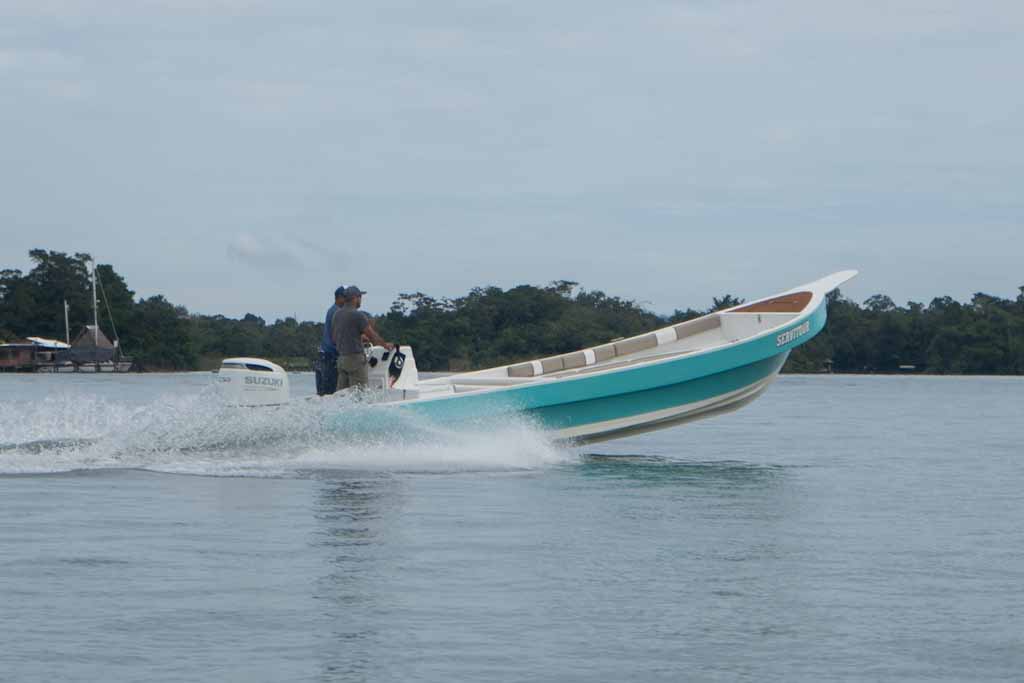
It is almost being off-the-beaten path off-the-beaten path off-the-beaten path. Guatemala is not a common travel destination. The eastern area around Rio Dulce town is the unknown side of the country. And from there you can only get by boat to Livingston, at the coast, through a spectacular gorge.
That sounds cool, but it obviously is a huge endeavour to even get there. And to be frankly, the towns of Rio Dulce nor Livingston are good-looking. But Rio Dulce has the waterside location, fish food and a rebuilt old Spanish fortress going for it. And Livingston is home to the Garifuna culture, an African-Caribbean vibe that keeps life unassuming and relaxed.
CONTENTS
General introduction
Getting there is the hard part. Rio Dulce and Livingston are squeezed into the eastern corner of Guatemala, under Belize and next to Honduras. Rio Dulce is located more inland, at the point where Lago Izabal and the El Golfete lakes meet. At the narrow connection point you find Rio Dulce, stretched along the big road. In the old days both sides of the village were connected by a ferry, now there is a huge bridge.
‘Lakes’ is technically not correct, because Izabal and Golfete are connected to the Atlantic Ocean, through a narrow gorge between Golfete and that ocean. That’s how you end up in Livingston on the Caribbean coast. It is also the reason why many Americans and Canadians with their yachts come to Rio Dulce during hurricane season, because it is well-protected against the elements.
That doesn’t mean the yachts make Rio Dulce a posh luxurious place. Along the main road, the town is a loud mess of trucks, buses and Tuk-Tuks. Most guesthouses are decent and located at the water, some can even only be reached by boat. But you don’t go to Rio Dulce for the beauty of the place, with some notable exceptions.
Livingston doesn’t have the loudness of trucks and buses. It hardly has cars even, as it can only be reached by boat. The trip from Rio Dulce is a highlight. Livingston is the heart of Garifuna culture, with its own music and food. It makes for a relaxed population, though the town has its rough edges, especially at night. And the beaches are mediocre, which makes a one-night stay the best idea. The good thing about Livingston though is that really all accommodation is immediately at the waterside.
Food and drinks
Obviously in Rio Dulce all gastronomy is concentrated around the main road, and more specifically the bridge. An excellent place for seafood is restaurant El Viajero, with great views of the water and bridge. On the other side of the bridge the Sundog cafe is a good place for drinks and food as well, just like the laidback and slightly hidden Jocelyn. Most of these places are open, under a roof.
Livingston has a couple of small resort hotels with more upmarket food. The rest are fairly typical local food options, with lots of fish dishes obviously. Buga Mama, next to the place where the boats (lanchas) land, is the one not to ignore. For what its worth: we stayed and ate at the Casa Nostra hotel and restaurant, in a quieter part close to the lancha dock.
Activities / things to do
It isn’t the most exciting part of the country, but there are plenty of options to entertain yourself a couple of days:
- the boatride: the main reason to come here. When you get to your hotel in Rio Dulce or Livingston, ask at the reception to make a reservátion for a public lancha. There are several boats going, usually in the morning (around 8.30/9am) and early afternoon (until around 3pm, when the sea often gets rougher). It is a beautiful itinerary, stopping left and right to enjoy the nature and show some highlights, from iguanas to dense jungle and birds. The ride takes 75-90 minutes, the part close to Livingston stands out for its gorge. You can do this stretch back and forth, like we did, alternatively you can also make it one-directional by including Puerto Barrios. That would also be the jumping/arrival point to/from Guatemala by the way
- beaches:
- Livingston doesn’t have a lot of good ones. Playa Quehueche is a 45 minute walk, right after the nice hanging bridge. It is relatively narrow and water is extremely shallow
- continue 30 minutes more northwest and you end up at Siete Altares, a collection of waterfalls
- Playa Blanca is even further and almost only accessible by boat. Plenty of lanchas will take you there from the village
- Castillo de San Felipe de Lara: a one hour walk along a road, or a short ride by Tuk-Tuk or collectivo, is this former Spanish fortress. It was partially destroyed centuries ago, and completely rebuilt several decades ago. It isn’t huge, but interesting nonetheless
- for one night we stayed in the Boatique Hotel in Rio Dulce, which can only be reached by boat. Amazing place in the jungle, but it is here in the Activity section because they do tours in the nearby monkey reserve as well. The howler monkeys will wake you up at night!
Getting to Rio Dulce/Livingston and getting around
- Livingston can only be reached by boat. As mentioned from Rio Dulce and Puerto Barrios, but there are also direct connections to nearby Belize and probably to Honduras as well
- Rio Dulce can only be reached by car and bus. Transportes Fuente del Norte have the most buses here, not all connections show up on their website. From Guatemala City the Litegua company is also a good option. Their office in Rio Dulce is close to the bridge, opposite is a shabby ticket office for all other bus companies. Most common connections are to/from Flores (4 hours) and Guatemala City (6 hours)
Miscellaneous
- Weather: jungleland, so things can get humid here. It is continuously warm (up and around 30 degrees) during the day. Beware of mosquitoes, also during the day (dengue mosquitoes are more active during daylight, and malaria is also an issue here)
- Safety: generally okay. Rio Dulce can be rowdy and loud, especially with the party people. Livingston can feel sketchy after dark, especially when the town goes quiet. If you don’t feel comfortable, get a taxi back to your accommodation