One would almost say: let the pictures do the talking. Until January 2026 I only knew the name Tikal from the famous board game, that hunt for artefacts in a Central American jungle. That jungle really exists. The temples do as well, rising up just above the trees to form a semi-secret settlement in No Man’s Land.
Let’s make the comparison immediately. In early 2019 I visited Palenque, also in the jungle, also a Mayan city, albeit on the Mexican side of the border. Vast swaths of tourists unleashed unto a small site, with several iconic buildings of which only one high one was accessible to the public. ‘Incredibly refined, a bit like Florence compared to Rome’, is what ChatGPT tells me.
Which means I just visited Rome, because Tikal is much bigger. In the Mayan days it was a mega-city, hidden deep in the jungle of what we now call Guatemala. It had huge military significance and was made to impress. Which it still shows, even in its deteriorated current state.
It is an adventure in itself to get here. Probably the most practical way to visit the Mundo Maya, as it is being marketed by the government, is from Belize. Because it is so far in the northeast of Guatemala. A ten hour night bus from the capital Guatemala City. Which is the reason I decided to skip it during my first visit to the country in 2019, immediately following Palenque.
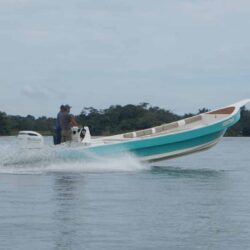
This time Tikal was the entire reason of going here. First to Rio Dulce and Livingston, the villages on the east coast connected by a spectacular high-speed boatride through gorges and jungle. A smart way to chop the trip from Guatemala City to Tikal in two almost equal parts.
The second part for most people ends in Flores, the little town on an island in a lake. The pictures are almost irresistible: colourful houses, great bars and restaurants at the waterside, a nice boulevard encircling the island making for a great thirty minute walk. Although when we visited there was high water, the neat boulevard invaded by water and impossible to walk.
Anyway, we decided against touristy Flores as our base. The long-distance bus dropped us in an industrial area of mainland Flores, next to the station for the famous collectivos: small vans for around ten people mainly used by the Guatemalan population. We barely fitted in for the one hour adventure that followed. After a rather chaotic visit to the local market, which proved to be a major pick-up point for passengers and especially cargo, we were on our way to El Remate. A small village on the lake, much closer to Tikal.
Our hideout proved to be gorgeous though slightly uncomfortable. Beautiful views of the Guatemalan national tree, even better views of sunset from a platform dead bang on the water. That was even served by a mini-cablecar for drinks and food from the restaurant of the guesthouse. But that guesthouse was a rather creaky wooden construction, and our rooms were directly under the creaky restaurant floor of the creaky building. On top of that, of course, massive amounts of mosquitoes even during daylight hours. This is the jungle after all, with dengue and malaria an unlikely but still real threat.
Many tourists opt to go very early into Tikal, to catch the sunrise from one of the pyramids. But apart from the inconvenient time (sunrise around 6am), it would have meant a tedious expensive endeavour. A private taxi for the 30-45 minute ride, then a mandatory private guide to take you onto the pyramids in the dark. Because the park hasn’t officially opened at that time.
So for once we opted for the sensible solution: buying tickets online, taking the collectivo (including dropping off someone’s laundry somewhere) in the morning and making our effort in the stiffling heat. Which turned out to be not as bad as originally feared.
There were more warnings that turned out to be unnecessary. Maybe during weekends it gets really busy here, but on this weekday it was quiet. In some parts of the vast site we were even on our own. And then to think that the part that is open to the public is only a small part of the national park Tikal: from the entrance gate to the actual entrance it was still easily 17 kilometres of driving.
Still, there were warnings in the tourist guides that the park is way too big to watch everything on one day, and the distances between the various temples was huge. Again: don’t believe what you read or hear. Yes, it is a considerable walk in the hot jungle. But within 3-4 hours we managed to see almost all of the highlights.
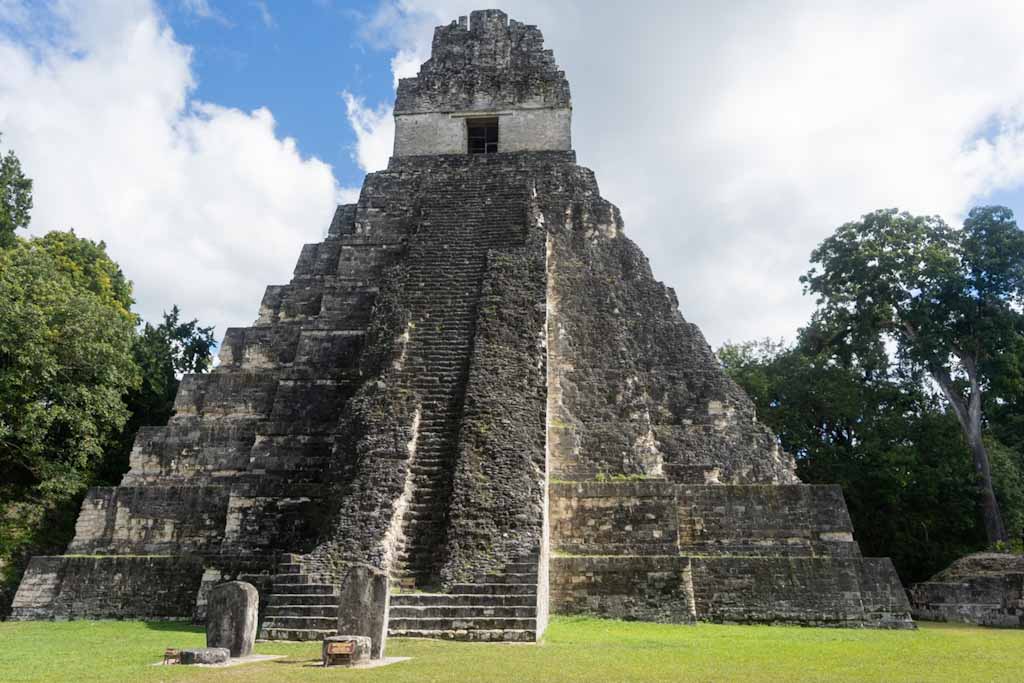
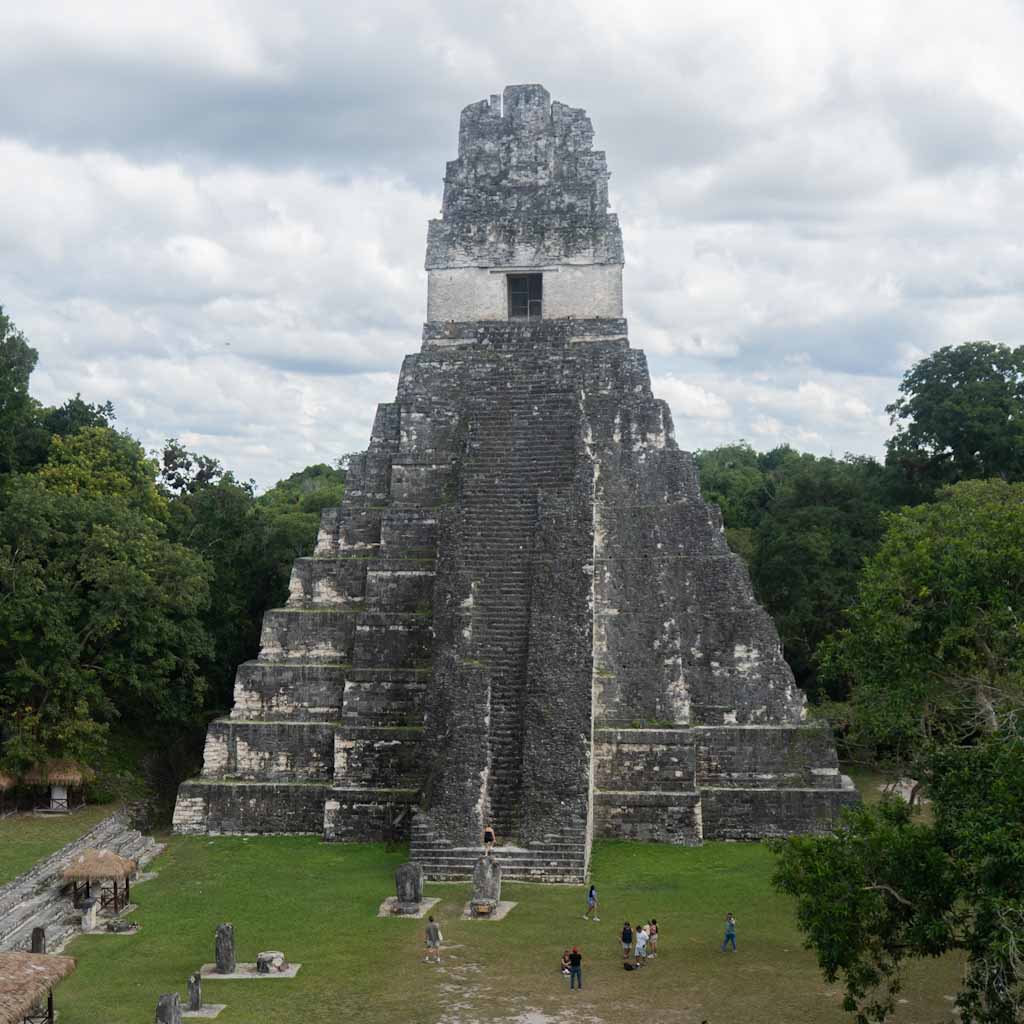
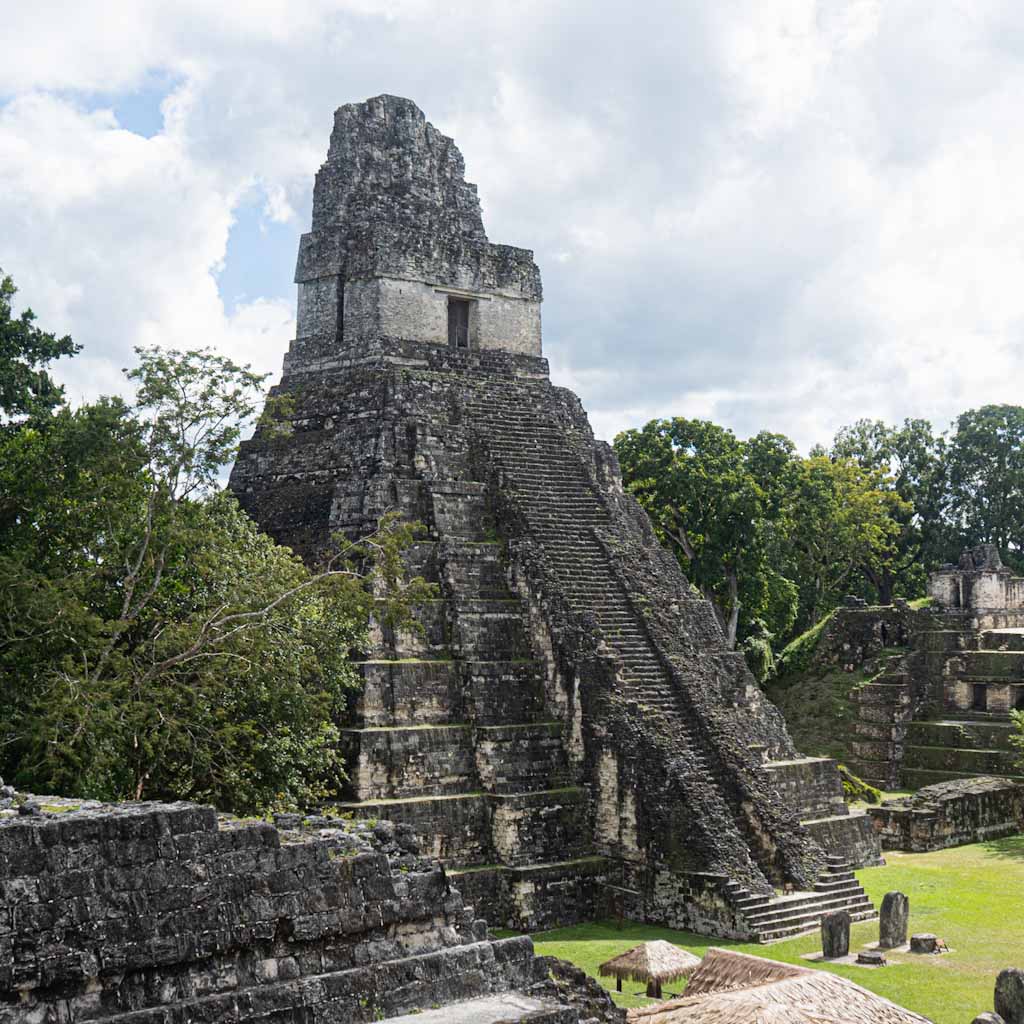
So what do those feel like? Well, Tikal gives itself away only slowly. An initial fifteen minute walk takes you to a marketplace. Nothing special, you think, until you turn a corner and discover Temple I (Gran Jaguar) and opposite also Temple II, just as steep and that one accessible by wooden stairs. This is a majestic place, with the terraced Acropolis North and the Acropolis Central on its flanks. There is a lot to explore here.
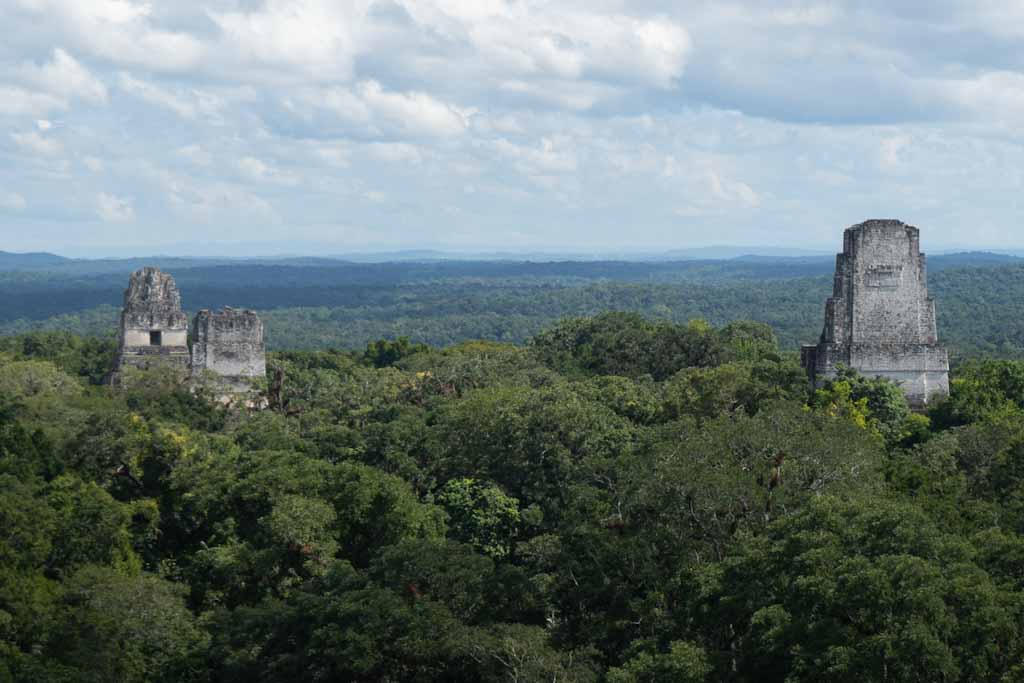
There are plenty of complexes with smaller pyramids hidden within ten minute walks of the central square. But the biggest attraction of them all is the Templo IV at the edge of the park. It can also be climbed by wooden stairs, albeit not entirely to the top. But this structure is so high it is responsible for the beautiful pictures from just over the treeline, with some of the highest Tikal structures giving away their presence right above the dense forest. This is the perfect place for those sunset views as well.
The party still isn’t nearly over. A fifteen minute walk away is the Mundo Perdido, the lost world, another marketable place. It has another high pyramid, pretty square this one, with another amazing view over the treetops. And much quieter than Temple VI as most visitors seem to focus on the absolute highlights only.
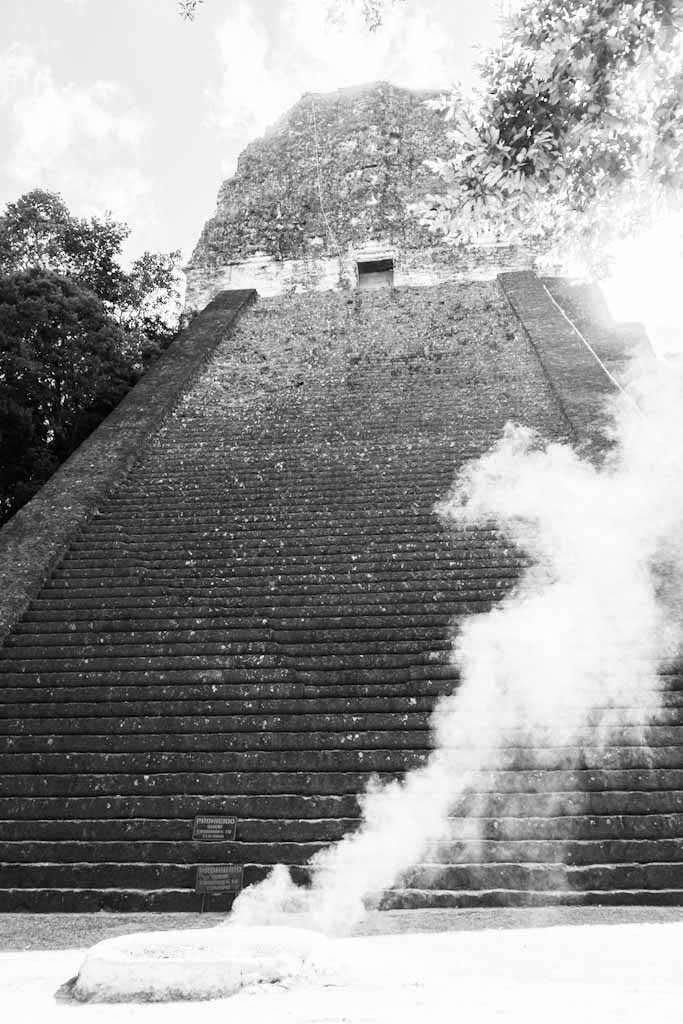
We reach total silence and max loneliness a bit later. The Plaza de los Siete Templos (place of seven temples) needs some imagination to see how it used to be. An imagination not needed for Templo V, which seems to have a small geyser puffing out smoke all day at its base. You are unfortunately not allowed to climb the old stairs, which have an angle of between 45 degrees to a whopping 70 degrees.
There are more hidden gems here in this corner, though not as high as Templo V. And it is of course still a 20-30 minute walk from here back to the visitors entrance. Where a collectivo will take you back to El Remate (45 minutes) or Flores (90 minutes), though most tourists seem to have opted for private shuttles booked through their hotels. More comfortable, much more expensive and less adventurous as well.
Which brought us back to our views of the national tree. The sunset over the lake. The plato tipicos in the creaky restaurant. And the realization of having seen the biggest Mayan site of all, even bigger than the more famous Chichen Itza in Mexico. But that one is more accessible, whereas Tikal hides itself better in the jungle, accessible only through that one road, far far away from population centers. You have to work harder to discover it, but maybe that is also one of its biggest charms?
Practical info:
- you should buy a ticket for the park online in advance through the official Tikal site. Otherwise you need to pay with cash at the entrance gate, which can be complicated. Tickets for foreigners are more expensive than for Guatemalans and permanent residents. A ticket does not include costs for a guide
- a quick and cheap way to get to Flores is by plane. There are several connections daily to Guatemala City, for a price that is not too different from a long-distance bus